
10. Light-Reflection and Refraction-Refraction by Spherical Lenses Science Class 10 In English-CBSE Notes
Explore science cbse notes for Class 10 Chapter 10. Light-Reflection and Refraction Topic Refraction by Spherical Lenses in English medium for exams preparation.
10. Light-Reflection and Refraction-Refraction by Spherical Lenses Science Class 10 In English-CBSE Notes
Popular Topics Covered
Our study material includes
- cbse notes for class 10 science chapter 10. Light-Reflection and Refraction topic Refraction by Spherical Lenses in english
- class 10 science chapter 10. Light-Reflection and Refraction cbse notes
- cbse class 10 science chapter 10. Light-Reflection and Refraction notes in english
- class 10 science chapter 10. Light-Reflection and Refraction study notes
- class 10 science chapter 10. Light-Reflection and Refraction revision notes
- cbse notes for class 10 science chapter 10. Light-Reflection and Refraction
- class 10 science chapter 10. Light-Reflection and Refraction summary notes
- cbse class 10 science chapter 10. Light-Reflection and Refraction quick notes
All Topics Chapter 10. Light-Reflection and Refraction
- 1. Introduction
- 2. Refraction of light
- 3. Refraction by Spherical Lenses
- 4. Image Formation by Lenses
- 5. page 5
Notes
10. Light-Reflection and Refraction-Refraction by Spherical Lenses Science Class 10 In English-CBSE Notes
10. Light-Reflection and Refraction
Refraction by Spherical Lenses
Refraction by Spherical Lenses:
Lens: A piece of glass or other transparent material bound by two
surfaces, of which one or both surfaces are spherical, forms a lens. This means that a lens is bound by at least one spherical surface.
Category of Lens: There are two types of lens.
(i) Convex lens: A lens which spherical surfaces bulging outward, such a lens is called a double convex lens. It is simply called a convex lens. It converges light rays hence convex lenses are also called converging lenses.
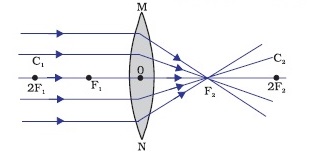
Features of convex lens:
(i) It is thicker at the middle as compared to the edges.
(ii) Convex lens converges light rays.
(ii) Concave Lens: A lens which is bounded by two spherical surfaces and curved inwards such lens is called concave lens. Concave lens is thicker at the edges than at the middle and it diverge light rays so it is called diverging lens. A double concave lens is simply called a concave lens.
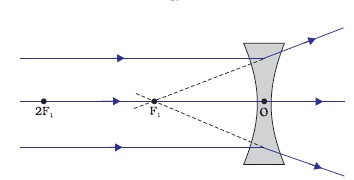
Features of concave lens:
(i) Concave lens is thicker at the edges than at the middle.
(ii) It diverge light rays
Parts of Spherical Lens:
(i) Centers of Curvature: A lens, either a convex lens or a concave lens, has two spherical surfaces. Each of these surfaces forms a part of a sphere. The centres of these spheres are called centres of curvature of the lens.
The centre of curvature of a lens is usually represented by the letter C.
Since there are two centres of curvature, we may represent them as C1
and C2.
(ii) Principal axis: An imaginary straight line passing through the two centres of curvature of a lens is called its principal axis.
(iii) Optical Centre: The central point of a lens is its optical centre. It is usually represented by the letter O.
(iv) Aperture: The effective diameter of the circular outline of a spherical lens is called its aperture.
(v) Thin lens with small aperture: Lenses whose aperture is much less than its radius of curvature. Such lenses are called thin lenses with small apertures.
(vi) Principal Focus of convex lens: A point on the principal axis on which light rays after refraction from the lens converge, this point is called principal focus of convex lens.
(vii) Principal Focus of concave lens: Light rays after refraction from the lens, are appearing to diverge from a point on the principal axis. This point on the principal axis is called the principal focus of the concave lens.
Letter F is usually used to represent principal focus. However, a lens has two principal foci. They are represented by F1 and F2.
See the fig.
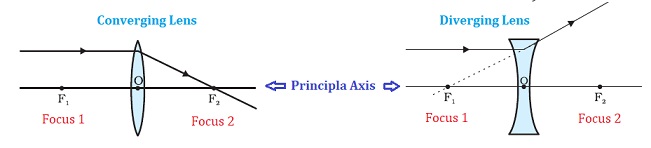
Image of sun on paper sheet by using lens:
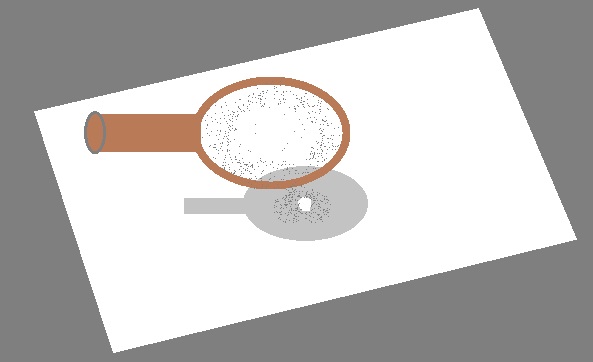
When we point a lens over a paper sheet for sometimes. The paper begins to burn producing smoke. It may even catch fire after a while. The light from the Sun constitutes parallel rays of light. These rays were converged by the lens at the sharp bright spot formed on the paper. In fact, the bright spot you got on the paper is a real image of the Sun. The concentration of the sunlight at a point generated heat. This caused the paper to burn.
(viii) Focal Length: The distance of the principal focus from the optical centre of a lens is called its focal length. The letter f is used to represent the focal length.
All Topics Chapter 10. Light-Reflection and Refraction
10. Light-Reflection and Refraction-Refraction by Spherical Lenses Science Class 10 In English-CBSE Notes
Hindi Medium Students/Teachers/Tutors:
All Chapters science Class 10
CBSE Notes for Class 10 science Chapter 10. Light-Reflection and Refraction – Refraction by Spherical Lenses
The CBSE Notes for Class 10 science Chapter 10. Light-Reflection and Refraction – Refraction by Spherical Lenses are prepared to help students understand every concept in a simple, clear, and well-organized manner. These notes are based on the latest CBSE syllabus and are suitable for regular classroom learning, homework, revision, and examination preparation. Every topic is explained using easy language so that students can learn important concepts without difficulty and develop a strong academic foundation.
Studying directly from the textbook is essential, but during revision students often need concise study material that highlights only the most important information. These chapter-wise notes provide exactly that. Instead of reading lengthy chapters repeatedly, students can quickly revise definitions, concepts, facts, examples, and important points in a short period of time. This approach saves valuable study time while improving understanding and retention.
Why Study Chapter 10. Light-Reflection and Refraction – Refraction by Spherical Lenses Using Our Notes?
Every chapter contains several important concepts that require careful understanding. Our notes present these concepts in a logical sequence so students can connect ideas easily. Difficult topics are simplified with easy explanations, making learning enjoyable for students of different learning abilities. Whether you are preparing for classroom discussions, assignments, periodic tests, or annual examinations, these notes provide a reliable source for effective revision.
- Prepared according to the latest CBSE curriculum.
- Simple and student-friendly explanations.
- Chapter-wise organized content for easy learning.
- Important concepts, definitions, and key points included.
- Useful for quick revision before examinations.
- Supports self-study and classroom learning.
- Helps improve conceptual understanding and confidence.
- Suitable for homework, assignments, and test preparation.
Benefits of Reading CBSE Notes Regularly
Consistent revision is one of the most effective ways to achieve academic success. Reading CBSE Notes for Class 10 science Chapter 10. Light-Reflection and Refraction – Refraction by Spherical Lenses regularly helps students remember important information for a longer period. Since the content is arranged systematically, students can identify important topics quickly and revise them whenever required.
These notes also help students improve answer-writing skills by presenting information in a structured format. Instead of memorizing lengthy paragraphs, students learn how to organize answers using important points and concepts. This not only improves writing quality but also increases confidence during examinations.
How to Use These Notes Effectively
To get the best results, students should first read the NCERT textbook carefully and understand the chapter. After completing the textbook, they should study these notes to reinforce important concepts. During revision, students can focus on highlighted definitions, important facts, and key ideas before solving textbook exercises and practice questions. This learning strategy improves both understanding and long-term memory.
Teachers and parents can also use these notes as a quick reference while helping students revise lessons or complete assignments. Since the content is concise and well-organized, it becomes easier to explain difficult topics within a limited amount of time.
Features of Our CBSE Notes
Every chapter on our platform is created with the objective of making learning easier for students. Our educational team regularly reviews and updates the content according to the latest CBSE guidelines so that students always receive reliable and accurate study material.
- Easy-to-understand chapter explanations.
- Important definitions and key concepts.
- Well-structured content for faster revision.
- Based on the latest CBSE syllabus.
- Helpful for school exams and annual examinations.
- Free online access on desktop and mobile devices.
Prepare Better with Chapter-wise CBSE Notes
Success in examinations depends on consistent practice and smart revision. These CBSE Notes for Class 10 science Chapter 10. Light-Reflection and Refraction – Refraction by Spherical Lenses are designed to reduce study pressure by presenting important information in a concise and meaningful way. Students can use them throughout the academic session for daily learning as well as last-minute revision before examinations.
Along with these notes, students are encouraged to solve NCERT textbook questions, practice important questions, and attempt sample papers regularly. Combining concept-based learning with regular practice helps improve problem-solving ability, analytical thinking, and overall academic performance. With disciplined study habits and quality learning resources, students can build confidence, strengthen their understanding of every chapter, and achieve excellent results in school examinations.
10. Light-Reflection and Refraction-Refraction by Spherical Lenses Science Class 10 In English-CBSE Notes Study Materials For Class 6 to 12
If you want to improve your academic performance, start studying with free CBSE notes for all classes. These notes are designed to make learning simple, clear, and effective for every student. Choose your class, explore the chapters, and begin your preparation with the latest cbse notes today.
