 Apurva Institute
Chapter 7. Tribes Nomads And Settled Communities-NCERT Exercise History Class 7 In English
Last Updated : 06 March 2026
Chapter 7. Tribes Nomads And Settled Communities Class 7 History solutions Topic NCERT Exercise . Read and download important answers for better exam preparation.
Chapter 7. Tribes Nomads And Settled Communities-NCERT Exercise History Class 7 In English
Last Updated : 06 March 2026
Chapter 7. Tribes Nomads And Settled Communities-NCERT Exercise History Class 7 In English
Chapter 7. Tribes Nomads And Settled Communities
NCERT Exercise
Exercise - Question:
Que: Match the following:
garh khel
tanda chaurasi
labourer caravan
clan Garha Katanga
Sib Singh Ahom state
Durgawati paik
Ans:
| Garh | Chaurasi |
| Laborer | Carvan |
| Clan | Khel |
| Sib Singh | Ahom state |
| Durgawati | Garha Katanga |
Que: Fill in the blanks:
(a) The new castes emerging within varnas werecalled ____________.
(b) _____________ were historical works written by theAhoms.
(c) The ____________ mentions that Garha Katangahad 70,000 villages.
(d) As tribal states became bigger and stronger, theygave land grants to _________ and ________.
Ans:
(a) Jatis
(b) buranjis
(c) Akbar Nama
(d) poets, scholars.
Que: State whether true or false:
(a) Tribal societies had rich oral traditions.
(b) There were no tribal communities in the northwesternpart of the subcontinent.
(c) The chaurasi in Gond states contained severalcities.
(d) The Bhils lived in the north-eastern part of thesubcontinent.
Ans:
(a) True
(b) False
(c) False
(d) False
Que: What kinds of exchanges took place between nomadicpastoralists and settled agriculturists?
Ans:
(i) They exchange milk, other pastrol products such as wool, ghee, etc.
(ii) Agriculture gave them grain, cloth, utensiland other products.
Que: How was the administration of the Ahom stateorganised?
Ans:
(i) The Ahom state depend upon forced labour or paiks.
(ii) The census of the population was taken.
(iii) Each vilage had to send a number of paiks by rotation.
Que: What changes took place in varna-based society?
Ans:
(i) Smaller castes or jaitis emerged within varnas.
(ii) Many tribes and social groups were taken into caste-based society and given the status of jaitis.
(iii) Jaitis rather than varna, became the basis for organising society.
Que: How did tribal societies change after being organised into a state?
Ans:
(i) They began to envolve a centralised administrative system.
(ii) Some social divisons within a tribal society also took place.
(iii) Tribal kings also began to grant land to Brahmputras, poets and scholar.
Que: Were the Banjaras important for the economy?
Ans: The Banjaras were very important for the economy. They were trader-nomads and controlled trade and commerce. They played an important role in transporting grain to the city markets. They usually bought grain where it was cheaply available and carried it to places where it was dearer. From there, they again reloaded their oxen with anything that could be profitably sold in other places.
Que: In what ways was the history of the Gonds different from that of the Ahoms? Were there any similarities?
Ans: The history of the Gonds was different from that of the Ahoms in the following ways:
- Gonds lived in Gondwana while Ahoms lived in Brahmaputra valley.
- Gonds practiced shifting cultivation while Ahoms did not practice shifting cultivation.
- Gond kingdoms were large, Ahom kingdom was small.
- Gond kingdoms were divided into garhs, Ahoms built a large state.
- Gonds did not use fire-arms, Ahoms used fire-arms for the first time in the history of the subcontinent.
The similarity is that both were tribes:
- The Mughals tried to control the lands of both at different point of time.
- There were changes in society of both due to the diversification of occupations.
Que: Plot the location of the tribes mentioned in this chapter on a map. For any two, discuss whether their mode of livelihood was suited to the geography and the environment of the area where they lived.
Ans: Several tribes live in different parts of India. See the map given below
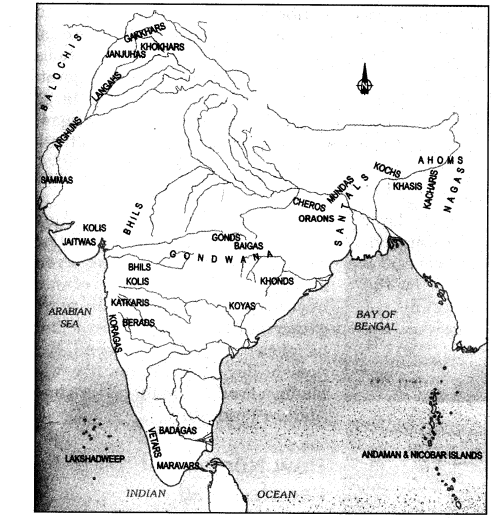
These tribes settled temporarily at the places which suited them as per their need and livelihood. Whenever they found the environment or their mode of living unfavourable, they migrated to other suitable places.
Que: Find out about present-day government policies towards tribal populations and organise a discussion about these.
Ans:
Policies about Tribal population
- Overall upliftment.
- Land rights.
- Education.
- Cultural and social upliftment.
- Roads, water, industries.
- Mainstreaming.
- Enforcement of reservation in government jobs.
Que: Find out more about present-day nomadic pastoral groups in the sub-continent.
Ans: What animals do they keep? Which are the areas frequented by these groups? Ans. Present-day nomadic pastoral groups in the sub-continent are – Gaddi shepherds living in the western Himalayas, Gujjar Bakarwals, living in Jammu & Kashmir, Banjaras living in Rajasthan. These nomadic people keep sheep, goats, and camels. They frequently visit the Kumaon region of Uttarakhand, Jammu & Kashmir, and Rajasthan.
Why Our NCERT Solutions Is Matters For Your Study?
NCERT Solutions are one of the most trusted study resources for students preparing for school exams and board examinations. These solutions help students understand every concept clearly and improve their academic performance. In today’s competitive education system, simply reading the textbook is not enough. Students need proper explanations and accurate answers to understand topics in depth. That is why NCERT Solutions for Classes 6 to 12 are considered essential for effective learning and exam preparation.
On this page, students can find latest NCERT Solutions prepared according to the current CBSE syllabus. These solutions are created by subject experts to help students understand every question in a simple and easy way. With the help of chapter-wise NCERT answers, students can quickly revise important topics and strengthen their concepts. Whether you are preparing for school tests, annual exams, or board exams, these NCERT textbook solutions will guide you step by step.
NCERT Solutions for Class 7 history Chapter Chapter 7. Tribes Nomads And Settled Communities Topic NCERT Exercise
NCERT Solutions for Class 7 history Chapter Chapter 7. Tribes Nomads And Settled Communities Topic NCERT Exercise are prepared to help students understand important concepts of the chapter in a simple and clear manner. These solutions are based on the latest CBSE syllabus and follow the official NCERT textbooks. Students who are searching for accurate answers and step-by-step explanations can use these solutions to improve their learning and prepare better for school exams as well as board examinations.
In this section you will find Class 7 history NCERT Solutions covering important questions, explanations and concept-based answers. Each question from the NCERT book is solved carefully so that students can understand how to write answers correctly in examinations. These solutions are also useful for quick revision before tests and assignments.
Why NCERT Solutions Are Important for Class 7 history
NCERT books are considered the most reliable study material for CBSE students. Most examination questions are directly based on NCERT textbooks. Therefore studying NCERT Solutions for Class 7 history helps students understand the exact pattern of questions and the correct method of answering them.
By practicing the questions from Chapter Chapter 7. Tribes Nomads And Settled Communities, students can strengthen their conceptual knowledge and improve their analytical thinking skills. These solutions also help students identify the most important topics and prepare effectively for school examinations.
About Chapter Chapter 7. Tribes Nomads And Settled Communities of Class 7 history
Chapter Chapter 7. Tribes Nomads And Settled Communities is an important part of the Class 7 history syllabus. This chapter explains several key concepts which are essential for understanding the subject in detail. Students often face difficulties while solving textbook questions related to this chapter. That is why NCERT Solutions for Chapter Chapter 7. Tribes Nomads And Settled Communities are provided to explain every concept in a simple and structured way.
The explanations provided here follow the official NCERT approach so that students can easily relate them to their textbook content. By studying these answers carefully, students can learn how to structure their answers and present them clearly in exams.
Understanding Topic: NCERT Exercise
The topic NCERT Exercise plays a significant role in Class 7 history Chapter Chapter 7. Tribes Nomads And Settled Communities. Students must understand this topic clearly because it often appears in examinations in the form of short answer or long answer questions. The solutions provided here explain the topic in a step-by-step format so that students can easily grasp the concept.
By studying NCERT Exercise carefully, students can build a strong foundation in the subject and improve their overall academic performance. These solutions also help students revise the topic quickly before examinations.
Benefits of Using NCERT Solutions
- Concept clarity: Each answer explains the concept in simple language.
- Exam preparation: Solutions follow the CBSE exam pattern.
- Quick revision: Students can revise important questions quickly.
- Accurate answers: All solutions are based on the official NCERT textbook.
- Better understanding: Step-by-step explanations improve learning.
Students studying NCERT Solutions for Class 7 history Chapter Chapter 7. Tribes Nomads And Settled Communities can easily understand the important points of the chapter. These solutions are also useful for completing homework assignments and preparing for tests.
Study NCERT Solutions in english
These solutions are available in english medium so that students can easily understand the concepts in their preferred language. Whether students are studying in Hindi medium or English medium, these solutions help them learn the subject more effectively and prepare confidently for examinations.
By practicing questions from Class 7 history Chapter Chapter 7. Tribes Nomads And Settled Communities Topic NCERT Exercise , students can strengthen their conceptual understanding and improve their problem-solving skills.
Conclusion
In conclusion, NCERT Solutions for Class 7 history Chapter Chapter 7. Tribes Nomads And Settled Communities Topic NCERT Exercise provide complete guidance for students who want to understand the chapter thoroughly. These solutions make learning easier, help students revise important concepts and improve their exam performance. Students should practice these answers regularly to build strong fundamentals and achieve better results in their examinations.
Chapter 7. Tribes Nomads And Settled Communities-NCERT Exercise History Class 7 In English
Hindi Medium Students/Teachers/Tutors:
All Chapters history Class 7
Class Wise NCERT Solutions
Students can find NCERT Solutions for Class 6, Class 7, Class 8, Class 9, Class 10, Class 11, and Class 12 on this page. Each class includes detailed solutions for important subjects such as Science, Mathematics, Social Science, English, and Hindi. These solutions are carefully prepared to ensure accuracy and clarity.
- NCERT Solutions for Classes 6 to 8 – Ideal for building strong basic concepts.
- NCERT Solutions for Classes 9 and 10 – Helpful for board exam preparation.
- NCERT Solutions for Classes 11 and 12 – Important for advanced concepts and competitive exams.
Chapter 7. Tribes Nomads And Settled Communities-NCERT Exercise History Class 7 In English Study Materials For Class 6 to 12
Benefits of Studying with NCERT Solutions
Using online NCERT Solutions makes learning easier and more convenient. Students can access the study material anytime and anywhere using their mobile phone, tablet, or computer. This flexibility helps students manage their study time more efficiently and prepare better for exams.
- Easy online access anytime and anywhere.
- Time-saving preparation with ready solutions.
- Better practice with accurate answers.
- Effective revision before exams.
Improve Your Learning with NCERT Solutions
Regular practice with NCERT textbook solutions helps students strengthen their understanding of each subject. These solutions not only help students complete their homework but also improve their analytical and problem-solving skills. By studying chapter-wise answers, students can learn the correct way to write answers in exams and score better marks.
If you want to improve your academic performance, start studying with free NCERT Solutions for all classes. These solutions are designed to make learning simple, clear, and effective for every student. Choose your class, explore the chapters, and begin your preparation with the latest NCERT Solutions today.