
13. Magnetic Effects of Electric Current-Text-book Questions Science Class 10 In English
Last Updated : 06 March 2026
Explore science Solutions for Class 10 Chapter 13. Magnetic Effects of Electric Current Topic Text-book Questions in English medium.
13. Magnetic Effects of Electric Current-Text-book Questions Science Class 10 In English
Last Updated : 06 March 2026
13. Magnetic Effects of Electric Current-Text-book Questions Science Class 10 In English
13. Magnetic Effects of Electric Current
Text-book Questions
Chapter 13. Magnetic Effects of Electric Current
Text-book Questions:
Page 224:
Q1. Why does a compass needle get deflected when brought near a bar magnet?
Ans: As compass needle is also act like a bar magnet. When a compass needle is placed near a bar magnet due to repulsive force between unlike poles and attraction between two unlike poles take place. The compass needle gets deflected.
Page 228:
Q1. Draw magnetic field lines around a bar magnet.
Ans: The magnetic field lines are as shown in the figure.


Q2. List the properties of magnetic lines of force.
Ans: The properties of magnetic lines of force are as follows:
(i) The magentic field lines emerge from north pole and merge at the south pole.
(ii) Inside the magnet, the direction of field lines is from its south pole to its north pole.
(iii) The magnetic field lines are closed curves.
(iv) The magnetic field is stronger, where the field lines are crowded.
(v) Two field lines do not intersect/cross each other.
Q3. Why don’t two magnetic lines of force intersect each other?
Ans: This is so, magnetic field lines do not intersect each other. If they did, it would mean that at the point of intersection, the compass needle would point
towards two directions, which is not possible.
Page 229:
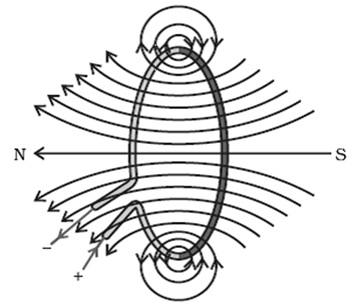
Q1. Consider a circular loop of wire lying in the plane of the table. Let the current pass through the loop clockwise. Apply the right-hand rule to find out the direction of the magnetic field inside and outside the loop.
Ans: According to right-hand rule, we observe that inside the loop, the magnetic field lines are directed perpendicular to the plane of paper in the inward direction. Outside the loop magnetic field lines are directed out of the plane paper.
Q2. The magnetic field in a given region is uniform. Draw a diagram to represent it.
Ans: When the magnetic field in a region is uniform, then the lines are parallel to each other, at the same distance and of equal length.
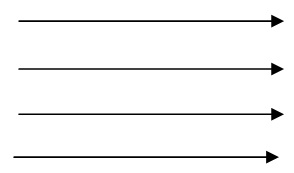
uniform magnetic field lines 
Q3. Choose the correct option.
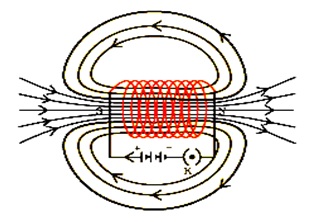
The magnetic field inside a long straight solenoid-carrying current
(a) is zero.
(b) decreases as we move towards its end.
(c) increases as we move towards its end.
(d) is the same at all points.
Ans:
(d) is the same at all points.
Page 231:
Q1. Which of the following property of a proton can change while it moves freely in a magnetic field?
(There may be more than one correct answer.)
| (a) mass | (b) speed |
| (c) velocity | (d) momentum |
Ans: (c) Velocity and (d) momentum
Q2. In Activity 13.7, how do we think the displacement of rod AB will be affected if;
(i) current in rod AB is increased;
(ii) a stronger horse-shoe magnet is used; and
(iii) length of the rod AB is increased?
Ans:
(i) O increasing the current in rod AB its displacement will increase.
(ii) If stronger horse-shoe magnet is used then the displacement of rod AB will increase.
(iii) If length of the rod is increased, force acting on it will increase and hence, displacement of the rod increases.
Q3. A positively-charged particle (alpha-particle) projected towards west is
deflected towards north by a magnetic field. The direction of magnetic
field is
| (a) towards south | (b) towards east |
| (c) downward | (d) upward |
Ans: According to the right hand thumb rule the direction of magnetic field will be vetically (d) upward.
Page 233:
Q1. State Fleming’s left-hand rule.
Ans: Fleming’s left-hand rule:
According to this rule, stretch the thumb, forefinger and middle finger of your left hand such that they are mutually perpendicular. If the first finger points in the direction of magnetic field and the second finger in the direction of current, then the thumb will point in the direction of motion or the force acting on the conductor.

Q2. What is the principle of an electric motor?
Ans: An electric motor is a rotating device that converts electrical energy to
mechanical energy. It is based on the principle in which a current carrying conductor experiences a force when placed in a magnetic field. If the direction of the magnetic field and that of the direction of current which pass through the magnetic field are mutually perpendicular then the direction of the force is given by Fleming’s left-hand rule.
Q3. What is the role of the split ring in an electric motor?
Ans: The split ring in a electric motor works as a commutator. It reverses the flowing of current in moter after a half rotation. Which gives rise to a contunuous roation of the coil and the axle.
Page 236:
Q1. Explain different ways to induce current in a coil.
Ans:
(a) Moving the coil in a magnetic field.
(b) By changing the magnetic field lines around the coil.
(c) It is convenient in most situations to move the coil in a magnetic field.
(d) The motion of a magnet with respect to the coil produces an induced potential difference, which sets up an induced electric current in the circuit.
Page 237:
Q1. State the principle of an electric generator.
Ans: The principle of electric generator is based on electromagnetic induction. When a rectangular coil is rotated in a uniform magnetic field, it produces induced electricity at the ends of the coil. This is the principle of the electric generator.
Q2. Name some sources of direct current.
Ans: Cell, battery and D.C generator or dynamo etc. are the sources of direct current.
Q3. Which sources produce alternating current?
Ans: A.C. Generators and Inverters etc. which generate alternating current.
Q4. Choose the correct option.
A rectangular coil of copper wires is rotated in a magnetic field. The direction of the induced current changes once in each
| (a) two revolutions | (b) one revolution |
| (c) half revolution | (d) one-fourth revolution |
Ans: (c) half revolution
Page 238:
Q1. Name two safety measures commonly used in electric circuits and appliances.
Ans: he names of two safety measures commonly used in electric circuits and appliances are -
(i) use of fuse and
(ii) Use of ground contact wire.
Q2. An electric oven of 2 kW power rating is operated in a domestic electric circuit (220 V) that has a current rating of 5 A. What result do you expect? Explain.
Ans: Power of electric tandoor (P) = 2 kW = 2000 W
Thus, the current drawn by the electric tandoor (I) = P/V
= 2000/220 = 9 A (approx.)
Whereas the current rating of the electric circuit is 5 A and the tandoor draws current at the rate of 9 A, so this circuit will break due to overheating or overloading.
Q3. What precaution should be taken to avoid the overloading of domestic electric circuits?
Ans: The following precautions should be taken to avoid overloading in domestic electrical circuits.
(i) Not more than one device should be connected to a single socket.
(ii) Always connect the electrical equipment in the circuit in parallel.
(iii) Suitable fuse should be used in the circuit.
(iv) Multiple electrical appliances should not be used at the same time to avoid overloading.
See All Topics Of this Chapters!!
Why Our NCERT Solutions Is Matters For Your Study?
NCERT Solutions are one of the most trusted study resources for students preparing for school exams and board examinations. These solutions help students understand every concept clearly and improve their academic performance. In today’s competitive education system, simply reading the textbook is not enough. Students need proper explanations and accurate answers to understand topics in depth. That is why NCERT Solutions for Classes 6 to 12 are considered essential for effective learning and exam preparation.
On this page, students can find latest NCERT Solutions prepared according to the current CBSE syllabus. These solutions are created by subject experts to help students understand every question in a simple and easy way. With the help of chapter-wise NCERT answers, students can quickly revise important topics and strengthen their concepts. Whether you are preparing for school tests, annual exams, or board exams, these NCERT textbook solutions will guide you step by step.
NCERT Solutions for Class 10 science Chapter 13. Magnetic Effects of Electric Current Topic Text-book Questions
NCERT Solutions for Class 10 science Chapter 13. Magnetic Effects of Electric Current Topic Text-book Questions are prepared to help students understand important concepts of the chapter in a simple and clear manner. These solutions are based on the latest CBSE syllabus and follow the official NCERT textbooks. Students who are searching for accurate answers and step-by-step explanations can use these solutions to improve their learning and prepare better for school exams as well as board examinations.
In this section you will find Class 10 science NCERT Solutions covering important questions, explanations and concept-based answers. Each question from the NCERT book is solved carefully so that students can understand how to write answers correctly in examinations. These solutions are also useful for quick revision before tests and assignments.
Why NCERT Solutions Are Important for Class 10 science
NCERT books are considered the most reliable study material for CBSE students. Most examination questions are directly based on NCERT textbooks. Therefore studying NCERT Solutions for Class 10 science helps students understand the exact pattern of questions and the correct method of answering them.
By practicing the questions from Chapter 13. Magnetic Effects of Electric Current, students can strengthen their conceptual knowledge and improve their analytical thinking skills. These solutions also help students identify the most important topics and prepare effectively for school examinations.
About Chapter 13. Magnetic Effects of Electric Current of Class 10 science
Chapter 13. Magnetic Effects of Electric Current is an important part of the Class 10 science syllabus. This chapter explains several key concepts which are essential for understanding the subject in detail. Students often face difficulties while solving textbook questions related to this chapter. That is why NCERT Solutions for Chapter 13. Magnetic Effects of Electric Current are provided to explain every concept in a simple and structured way.
The explanations provided here follow the official NCERT approach so that students can easily relate them to their textbook content. By studying these answers carefully, students can learn how to structure their answers and present them clearly in exams.
Understanding Topic: Text-book Questions
The topic Text-book Questions plays a significant role in Class 10 science Chapter 13. Magnetic Effects of Electric Current. Students must understand this topic clearly because it often appears in examinations in the form of short answer or long answer questions. The solutions provided here explain the topic in a step-by-step format so that students can easily grasp the concept.
By studying Text-book Questions carefully, students can build a strong foundation in the subject and improve their overall academic performance. These solutions also help students revise the topic quickly before examinations.
Benefits of Using NCERT Solutions
- Concept clarity: Each answer explains the concept in simple language.
- Exam preparation: Solutions follow the CBSE exam pattern.
- Quick revision: Students can revise important questions quickly.
- Accurate answers: All solutions are based on the official NCERT textbook.
- Better understanding: Step-by-step explanations improve learning.
Students studying NCERT Solutions for Class 10 science Chapter 13. Magnetic Effects of Electric Current can easily understand the important points of the chapter. These solutions are also useful for completing homework assignments and preparing for tests.
Study NCERT Solutions in english
These solutions are available in english medium so that students can easily understand the concepts in their preferred language. Whether students are studying in Hindi medium or English medium, these solutions help them learn the subject more effectively and prepare confidently for examinations.
By practicing questions from Class 10 science Chapter 13. Magnetic Effects of Electric Current Topic Text-book Questions, students can strengthen their conceptual understanding and improve their problem-solving skills.
Conclusion
In conclusion, NCERT Solutions for Class 10 science Chapter 13. Magnetic Effects of Electric Current Topic Text-book Questions provide complete guidance for students who want to understand the chapter thoroughly. These solutions make learning easier, help students revise important concepts and improve their exam performance. Students should practice these answers regularly to build strong fundamentals and achieve better results in their examinations.
13. Magnetic Effects of Electric Current-Text-book Questions Science Class 10 In English
Hindi Medium Students/Teachers/Tutors:
All Chapters science Class 10
Class Wise NCERT Solutions
Students can find NCERT Solutions for Class 6, Class 7, Class 8, Class 9, Class 10, Class 11, and Class 12 on this page. Each class includes detailed solutions for important subjects such as Science, Mathematics, Social Science, English, and Hindi. These solutions are carefully prepared to ensure accuracy and clarity.
- NCERT Solutions for Classes 6 to 8 – Ideal for building strong basic concepts.
- NCERT Solutions for Classes 9 and 10 – Helpful for board exam preparation.
- NCERT Solutions for Classes 11 and 12 – Important for advanced concepts and competitive exams.
13. Magnetic Effects of Electric Current-Text-book Questions Science Class 10 In English Study Materials For Class 6 to 12
Benefits of Studying with NCERT Solutions
Using online NCERT Solutions makes learning easier and more convenient. Students can access the study material anytime and anywhere using their mobile phone, tablet, or computer. This flexibility helps students manage their study time more efficiently and prepare better for exams.
- Easy online access anytime and anywhere.
- Time-saving preparation with ready solutions.
- Better practice with accurate answers.
- Effective revision before exams.
Improve Your Learning with NCERT Solutions
Regular practice with NCERT textbook solutions helps students strengthen their understanding of each subject. These solutions not only help students complete their homework but also improve their analytical and problem-solving skills. By studying chapter-wise answers, students can learn the correct way to write answers in exams and score better marks.
If you want to improve your academic performance, start studying with free NCERT Solutions for all classes. These solutions are designed to make learning simple, clear, and effective for every student. Choose your class, explore the chapters, and begin your preparation with the latest NCERT Solutions today.